

💉 Do you want an epidemic? Vaccinate a few people and divide society: the easiest way to make the masses sick 🧠

It is important to understand how a supposed “epidemic” can be generated from the perspective of German New Medicine (GNM).
When, in the last class of the Professional Training in GNM, I mentioned that it was “easy to create an epidemic by vaccinating just a few people,” I was referring to how biological separation conflicts can be activated in a large part of the population through media and social conditioning.
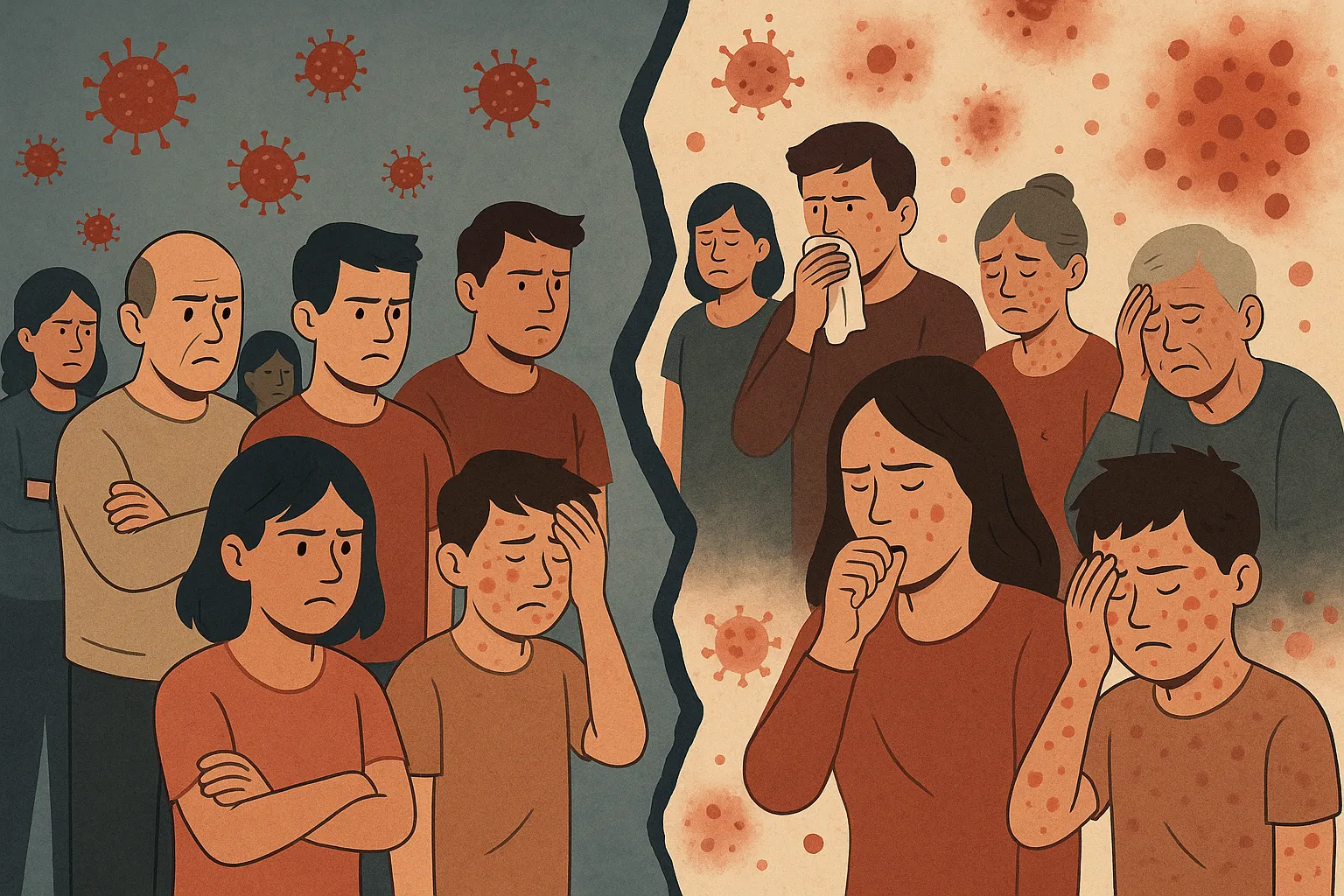
The vaccine itself does not cause the disease (although it can cause internal trauma, since we know that even distilled water is harmful when injected intravenously; experiments by A. Béchamp clearly show an affinity for the heart valves and possible complications). What can happen, however, is that when a few people begin to be vaccinated and this is massively publicized, a social division is created: on one side, those who get vaccinated and want to separate from the unvaccinated; on the other, those who do not get vaccinated and do not want to associate with the vaccinated. This division activates separation-from-contact conflicts (skin, mucous membranes, etc.) in both children and adults. The more one side pulls the rope and gains media exposure, the more both that group and the opposing one will get sick.
From GNM we know that when a person experiences, in a dramatic and isolated way, a conflict of separation and uprooting—such as “not being able to hug my grandparents,” “not being able to play with my friends,” or “being excluded from the group”—a specific biological program is activated that affects the epidermis (controlled by the cerebral cortex), generating ulceration in the active phase. Then, when the conflict is resolved, the repair phase appears, with symptoms such as rashes, fever, inflammation, and even diagnoses of diseases such as measles, chickenpox, or others considered “epidemic.” Fever may appear if the kidney collecting ducts were also affected when resolving the conflict of uprooting or abandonment.
And if what is intended is to activate a fear of death in society—through a terror campaign about a “deadly virus” or a threat of war—the conflict will impact the pulmonary alveoli, and once resolved, an epidemic of tuberculosis will develop. Let us remember that tuberculosis never disappeared: today it is simply called “cancer” when the Koch bacillus is found decomposing or necrotizing a tumor during the repair phase, since the official treatments of chemotherapy, radiation, and surgery represent revenues thousands of times higher than treating the Koch bacillus simply with rest.
To create a measles epidemic, only one thing is needed: generate media controversy. It does not matter whether confrontation between the “pro” and the “anti” is encouraged, or whether only one side is promoted. The only requirement is to generate division, conflict, and social separation. That is the real trigger. When that emotional tension is resolved—because children return to school, grandparents visit their grandchildren again, or restrictions are lifted—that is when symptoms appear, massively and predictably.
In summary: it is not the vaccine, nor the virus, nor a bacterium. It is the biologically lived conflict, experienced in a dramatic and unexpected way, that triggers an adaptive response of the body. And when this is lived on a mass scale, conditioned by the media, what we obtain is a perfectly manufactured epidemic.
An epidemic of H2N2 can also be “invented,” or any combination of letters and numbers one wishes to create. It is enough to name a supposed virus, blame it, spread it massively through the media, and associate it with specific symptoms. The reality is that each of those official symptoms corresponds to a specific biological program, originating in conflicts lived in a massive, dramatic, unexpected, and isolated way, which are now in their repair phase or epicrisis.
High fever: appears in the repair phase of endodermic (brainstem-controlled) conflicts, such as “not being able to digest” something experienced as repugnant or unjust. It affects organs such as the stomach or intestines.
Head and body aches: repair of devaluation conflicts in muscles, bones, or joints, often due to impotence, futile effort, or feeling incapable.
Extreme tiredness and intense fatigue: a typical sign of vagotonia after resolving a conflict; the body needs rest to heal, reorganize, and recover energy.
Dry, persistent cough: repair phase (or epicrisis) of fright-in-the-territory conflicts, or fear in the environment, affecting the bronchi or larynx.
Sore throat: repair phase of conflicts related to “not being able to grasp something” or “not being able to swallow” a real or symbolic situation—in this case, a social one.
Nasal congestion and discharge: repair phase following olfactory conflicts such as “not being able to smell” or “wanting to reject” a situation or person. In the active phase, ulceration of the nasal mucosa occurs; in repair, sneezing, edema, crusts, and itching appear.
General malaise: appears when the body is undergoing several repair programs at the same time, generating a feeling of physical collapse.
Vomiting: can occur at two moments—during the active phase of a conflict of “not being able to digest something” (stomach, endoderm), or during the epicrisis, with strong spasms to drain edema.
Diarrhea: occurs in the repair phase of a “morsel that advanced” conflict, or a situation that was finally assimilated. Smooth muscle function reactivates, since constipation was present beforehand. Constipation always precedes diarrhea.
These processes do not have an external origin. They are meaningful biological programs, designed to help the organism adapt, entirely internal. When many people live similar conflicts—induced by fear, separation, or social pressure—and then resolve them at the same time, what appears is what is called an “epidemic.” But there is no contagion: there are collective conflicts and individual repair processes.

Responses